--------------------------------------------------------
=linked   |causes the object module containing the
          |floating point emulator to be included in the
          |library (and linked into any image), along
          |with a small interface module to take control
          |of the illegal instruction vector on startup,
          |and relinquish it on closedown.
--------------------------------------------------------
=module   |floating point emulation is provided
          |externally in some way (present in ROM, for
          |example). In this case, if the
          |target-dependent kernel follows the code of
          |the riscos example, functions
          |__fp_initialise, __fp_finalise and
          |__fp_address_in_module must be provided.
--------------------------------------------------------
--------------------------------------------------------
=small    |memcpy, memmove and memset are implemented by
          |generic C code (which attempts to do as much
          |as possible in word units): each occupies
          |about 100 bytes.
--------------------------------------------------------
=fast     |memmove and memcpy are implemented together
          |in assembler, which attempts to do the bulk
          |of the move 8 words at a time using LDM/STM
          |(about 1200 bytes). memset is implemented
          |similarly (about 200 bytes).
--------------------------------------------------------
--------------------------------------------------------
=small     |the fully rolled implementations.
--------------------------------------------------------
=unrolled  |unsigned and signed divide are unrolled 8
           |times for greater speed, but obviously use
           |more code. Complete unrolling of divide is
           |possible, but should be done with care since
           |the significant size increase might give
           |decreased rather than increased performance
           |on a cached ARM. Whichever variant is
           |selected, fast unsigned and signed divide by
           |10 are included.
--------------------------------------------------------
--------------------------------------------------------
=on  |_main extracts Unix-style stdstream connection
     |directives from the image's argument string (<
     |, >, >>, >&, 1>&2).
--------------------------------------------------------
--------------------------------------------------------
=on  |the default signal handler ends by producing a
     |call-stack traceback to stderr. (Use of this
     |variant is not encouraged, since it increases the
     |proportion of the library that is linked into all
     |images, while providing functionality better
     |obtained from a separate debugger).
--------------------------------------------------------
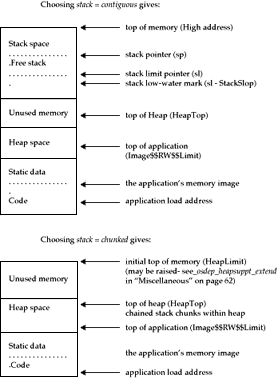
A third variant, like the first, but with the stack outside of the heap and not under the application's control, can easily be synthesised. This may be a more appropriate variant if there is a skeletal operating system which implements an address-mapped stack segment.