# 16. Interrupts ## Introduction {#sec-intro} Under certain conditions, you can make the CPU drop whatever it's doing, go run another function instead, and continue with the original process afterwards. This process is known as an interrupt (two ‘r’s, please). The function that handles the interrupt is an interrupt service routine, or just interrupt; triggering one is called raising an interrupt. Interrupts are often attached to certain hardware events: pressing a key on a PC keyboard, for example, raises one. Another PC example is the VBlank (yes, PCs have them too). The GBA has similar interrupts and others for the HBlank, DMA and more. This last one in particular can be used for a great deal of nifty effects. I'll give a full list of interrupts shortly. Interrupts halt the current process, quickly do ‘something’, and pass control back again. Stress the word “quickly”: interrupts are supposed to be short routines. ## Interrupts registers {#sec-regs} There are three registers specifically for interrupts: `REG_IE` (`0400:0200h`), `REG_IF` (`0400:0202h`) and `REG_IME` (`0400:0208h`). `REG_IME` is the master interrupt control; unless this is set to ‘1’, interrupts will be ignored completely. To enable a specific interrupt you need to set the appropriate bit in `REG_IE`. When an interrupt occurs, the corresponding bit in `REG_IF` will be set. To acknowledge that you've handled an interrupt, the bit needs to be cleared again, but the way to do that is a little counter-intuitive to say the least. To acknowledge the interrupt, you actually have to *set* the bit again. That's right, you have to write 1 to that bit (which is already 1) in order to clear it. Apart from setting the bits in `REG_IE`, you also need to set a bit in other registers that deal with the subject. For example, the HBlank interrupt also requires a bit in `REG_DISPSTAT`. I think (but please correct me if I'm wrong) that you need both a sender and receiver of interrupts; `REG_IE` controls the receiver and registers like `REG_DISPSTAT` control the sender. With that in mind, let's check out the bit layout for `REG_IE` and `REG_IF`.
| F E | D | C | B A 9 8 | 7 | 6 5 4 3 | 2 | 1 | 0 |
| - | C | K | Dma | Com | Tm | Vct | Hbl | Vbl |
| bits | name | define | description |
|---|---|---|---|
| 0 | Vbl | IRQ_VBLANK | VBlank interrupt. Also requires
REG_DISPSTAT{3}
|
| 1 | Hbl | IRQ_HBLANK | HBlank interrupt. Also requires
REG_DISPSTAT{4} Occurs after the HDraw, so that
things done here take effect in the next line.
|
| 2 | Vct | IRQ_VCOUNT | VCount interrupt. Also requires
REG_DISPSTAT{5}. The high byte of
REG_DISPSTAT gives the VCount at which to raise the
interrupt. Occurs at the beginning of a scanline.
|
| 3-6 | Tm | IRQ_TIMERx | Timer interrupt, 1 bit per timer. Also requires
REG_TMxCNT{6}. The interrupt will be raised
when the timer overflows.
|
| 7 | Com | IRQ_COM | Serial communication interrupt. Apparently, also requires
REG_SCCNT{E}. To be raised when the transfer
is complete. Or so I'm told, I really don't know squat about
serial communication.
|
| 8-B | Dma | IRQ_DMAx | DMA interrupt, 1 bit per channel. Also requires
REG_DMAxCNT{1E}. Interrupt will be raised
when the full transfer is complete.
|
| C | K | IRQ_KEYPAD | Keypad interrupt. Also requires
REG_KEYCNT{E}. Raised when any or all or the keys
specified in REG_KEYCNT are down.
|
| D | C | IRQ_GAMEPAK | Cartridge interrupt. Raised when the cart is removed from the GBA. |
REG_IF = IRQ_x’ is usually the correct course of action, and not ‘REG_IF |= IRQ_x’. The |= version acknowledges all interrupts that have been raised, even if you haven't dealt with them yet.
Usually, these two result in the same thing, but if multiple interrupts come in at the same time things will go bad. Just pay attention to what you're doing.
:::
### The interrupt process {#ssec-isr-proc}
The complete interrupt process is kind of tricky and part of it is completely beyond your control. What follows now is a list of things that you, the programmer, need to know. For the full story, see [GBATEK : irq control](https://problemkaputt.de/gbatek.htm#gbainterruptcontrol).
1. Interrupt occurs. Some black magic deep within the deepest dungeons of BIOS happens and the CPU is switched to IRQ mode and ARM state. A number of registers (`r0-r3, r12, lr`) are pushed onto the stack.
2. BIOS loads the address located at `0300:7FFC` and branches to that address.
3. The code pointed to by `0300:7FFC` is run. Since we're in ARM-state now, this *must* to be ARM code!
4. After the isr is done, acknowledge that the interrupt has been dealt with by writing to `REG_IF`, then return from the isr by issuing a `bx lr` instruction.
5. The previously saved registers are popped from stack and program state is restored to normal.
Steps 1, 2 and 5 are done by BIOS; 3 and 4 are yours. Now, in principle all you need to do is place the address of your isr into address `0300:7FFC`. To make our job a little easier, we will first create ourselves a function pointer type.
```c
typedef void (*fnptr)(void);
#define REG_ISR_MAIN *(fnptr*)(0x03007FFC)
// Be careful when using it like this, see notes below
void foo()
{
REG_ISR_MAIN= hbl_pal_invert; // tell the GBA where my isr is
REG_DISPSTAT |= VID_HBL_IRQ; // Tell the display to fire HBlank interrupts
REG_IE |= IRQ_HBLANK; // Tell the GBA to catch HBlank interrupts
REG_IME= 1; // Tell the GBA to enable interrupts;
}
```
Now, this will probably work, but as usual there's more to the story.
- First, the code that `REG_ISR_MAIN` jumps to *must* be ARM code! If you compile with the `-mthumb` flag, the whole thing comes to a screeching halt.
- What happens when you're interrupted inside an interrupt? Well, that's not quite possible actually; not unless you do some fancy stuff we'll get to later. You see, `REG_IME` is not the only thing that allows interrupts, there's a bit for irqs in the program status register (PSR) as well. When an interrupt is raised, the CPU disables interrupts there until the whole thing is over and done with.
- `hbl_pal_invert()` doesn't check whether it has been activated by an HBlank interrupt. Now, in this case it doesn't really matter because it's the only one enabled, but when you use different types of interrupts, sorting them out is essential. That's why we'll create an [interrupt switchboard](#sec-switch) in the next section.
- Lastly, when you use [BIOS calls](swi.html) that require interrupts, you also need to acknowledge them in `REG_IFBIOS` (== `0300:7FF8`). The use is the same as `REG_IF`.
:::warning On section mirroring
GBA's memory sections are mirrored ever so many bytes. For example IWRAM (`0300:0000`) is mirrored every 8000h bytes, so that `0300:7FFC` is also `03FF:FFFC`, or `0400:0000`−4. While this is faster, I'm not quite sure if this should be taken advantage of. no$gba v2.2b marks it as an error, even though this was apparently a small oversight and fixed in v2.2c. Nevertheless, consider yourself warned.
:::
## Creating an interrupt switchboard {#sec-switch}
The `hbl_pal_invert()` function is an example of a single interrupt, but you may have to deal with multiple interrupts. You may also want to be able to use different isr's depending on circumstances, in which case stuffing it all into one function may not be the best way to go. Instead, we'll create an interrupt switchboard.
An interrupt switchboard works a little like a telephone switchboard: you have a call (i.e., an interrupt, in `REG_IF`) coming in, the operator checks if it is an active number (compares it with `REG_IE`) and if so, connects the call to the right receiver (your isr).
This particular switchboard will come with a number of additional features as well. It will acknowledge the call in both `REG_IF` and `REG_IFBIOS`), even when there's no actual ISR attached to that interrupt. It will also allow nested interrupts, although this requires a little extra work in the ISR itself.
### Design and interface considerations {#ssec-switch-design}
The actual switchboard is only one part of the whole; I also need a couple of structs, variables and functions. The basic items I require are these.
- **`__isr_table[]`**. An interrupt table. This is a table of function pointers to the different isr's. Because the interrupts should be prioritized, the table should also indicate which interrupt the pointers belong to. For this, we'll use an `IRQ_REC` struct.
- **`irq_init()`** / **`irq_set_master()`**. Set master isr. `irq_init()` initializes the interrupt table and interrupts themselves as well.
- **`irq_enable()`** / **`irq_disable()`**. Functions to enable and disable interrupts. These will take care of both `REG_IE` and whatever register the sender bit is on. I'm keeping these bits in an internal table called `__irq_senders[]` and to be able to use these, the input parameter of these functions need to be the *index* of the interrupt, not the interrupt flag itself. Which is why I have `II_`*`foo`* counterparts for the `IRQ_`*`foo`* flags.
- **`irq_set()`** / **`irq_add()`** / **`irq_delete()`**. Function to add/delete interrupt service routines. The first allows full prioritization of isr's; `irq_add()` will replace the current irs for a given interrupt, or add one at the end of the list; `irq_delete()` will delete one and correct the list for the empty space.
All of these functions do something like this: disable interrupts (`REG_IME`=0), do their stuff and then re-enable interrupts. It's a good idea to do this because being interrupted while mucking about with interrupts is not pretty. The functions concerned with service routines will also take a function pointer (the `fnptr` type), and also return a function pointer indicating the previous isr. This may be useful if you want to try to chain them.
Below you can see the structs, tables, and the implementation of `irq_enable()` and `irq_add()`. In both functions, the `__irq_senders[]` array is used to determine which bit to set in which register to make sure things send interrupt requests. The `irq_add()` function goes on to finding either the requested interrupt in the current table to replace, or an empty slot to fill. The other routines are similar. If you need to see more, look in *tonc_irq.h/.c* in libtonc.
```c
//! Interrups Indices
typedef enum eIrqIndex
{
II_VBLANK=0, II_HBLANK, II_VCOUNT, II_TIMER0,
II_TIMER1, II_TIMER2, II_TIMER3, II_SERIAL,
II_DMA0, II_DMA1, II_DMA2, II_DMA3,
II_KEYPAD, II_GAMEPAK,II_MAX
} eIrqIndex;
//! Struct for prioritized irq table
typedef struct IRQ_REC
{
u32 flag; //!< Flag for interrupt in REG_IF, etc
fnptr isr; //!< Pointer to interrupt routine
} IRQ_REC;
// === PROTOTYPES =====================================================
IWRAM_CODE void isr_master_nest();
void irq_init(fnptr isr);
fnptr irq_set_master(fnptr isr);
fnptr irq_add(enum eIrqIndex irq_id, fnptr isr);
fnptr irq_delete(enum eIrqIndex irq_id);
fnptr irq_set(enum eIrqIndex irq_id, fnptr isr, int prio);
void irq_enable(enum eIrqIndex irq_id);
void irq_disable(enum eIrqIndex irq_id);
```
```c
// IRQ Sender information
typedef struct IRQ_SENDER
{
u16 reg_ofs; //!< sender reg - REG_BASE
u16 flag; //!< irq-bit in sender reg
} ALIGN4 IRQ_SENDER;
// === GLOBALS ========================================================
// One extra entry for guaranteed zero
IRQ_REC __isr_table[II_MAX+1];
static const IRQ_SENDER __irq_senders[] =
{
{ 0x0004, 0x0008 }, // REG_DISPSTAT, DSTAT_VBL_IRQ
{ 0x0004, 0x0010 }, // REG_DISPSTAT, DSTAT_VHB_IRQ
{ 0x0004, 0x0020 }, // REG_DISPSTAT, DSTAT_VCT_IRQ
{ 0x0102, 0x0040 }, // REG_TM0CNT, TM_IRQ
{ 0x0106, 0x0040 }, // REG_TM1CNT, TM_IRQ
{ 0x010A, 0x0040 }, // REG_TM2CNT, TM_IRQ
{ 0x010E, 0x0040 }, // REG_TM3CNT, TM_IRQ
{ 0x0128, 0x4000 }, // REG_SCCNT_L BIT(14) // not sure
{ 0x00BA, 0x4000 }, // REG_DMA0CNT_H, DMA_IRQ>>16
{ 0x00C6, 0x4000 }, // REG_DMA1CNT_H, DMA_IRQ>>16
{ 0x00D2, 0x4000 }, // REG_DMA2CNT_H, DMA_IRQ>>16
{ 0x00DE, 0x4000 }, // REG_DMA3CNT_H, DMA_IRQ>>16
{ 0x0132, 0x4000 }, // REG_KEYCNT, KCNT_IRQ
{ 0x0000, 0x0000 }, // cart: none
};
// === FUNCTIONS ======================================================
//! Enable irq bits in REG_IE and sender bits elsewhere
void irq_enable(enum eIrqIndex irq_id)
{
u16 ime= REG_IME;
REG_IME= 0;
const IRQ_SENDER *sender= &__irq_senders[irq_id];
*(u16*)(REG_BASE+sender->reg_ofs) |= sender->flag;
REG_IE |= BIT(irq_id);
REG_IME= ime;
}
//! Add a specific isr
fnptr irq_add(enum eIrqIndex irq_id, fnptr isr)
{
u16 ime= REG_IME;
REG_IME= 0;
int ii;
u16 irq_flag= BIT(irq_id);
fnptr old_isr;
IRQ_REC *pir= __isr_table;
// Enable irq
const IRQ_SENDER *sender= &__irq_senders[irq_id];
*(u16*)(REG_BASE+sender->reg_ofs) |= sender->flag;
REG_IE |= irq_flag;
// Search for previous occurance, or empty slot
for(ii=0; pir[ii].flag; ii++)
if(pir[ii].flag == irq_flag)
break;
old_isr= pir[ii].isr;
pir[ii].isr= isr;
pir[ii].flag= irq_flag;
REG_IME= ime;
return old_isr;
}
```
### The master interrupt service routine {#ssec-switch-master}
The main task of the master ISR is to seek out the raised interrupt in `___isr_table`, and acknowledge it in both `REG_IF` and `REG_IFBIOS`. If there is an irq-specific service routine, it should call it; otherwise, it should just exit to BIOS again. In C, it would look something like this.
```c
// This is mostly what libtonc's isr_master does, but
// you really need asm for the full functionality
IWRAM_CODE void isr_master_c()
{
u32 ie= REG_IE;
u32 ieif= ie & REG_IF;
IRQ_REC *pir;
// (1) Acknowledge IRQ for hardware and BIOS.
REG_IF = ieif;
REG_IFBIOS |= ieif;
// (2) Find raised irq
for(pir= __isr_table; pir->flag!=0; pir++)
if(pir->flag & ieif)
break;
// (3) Just return if irq not found in list or has no isr.
if(pir->flag == 0 || pir->isr == NULL)
return;
// --- If we're here have an interrupt routine ---
// (4a) Disable IME and clear the current IRQ in IE
u32 ime= REG_IME;
REG_IME= 0;
REG_IE &= ~ieif;
// (5a) CPU back to system mode
//> *(--sp_irq)= lr_irq;
//> *(--sp_irq)= spsr
//> cpsr &= ~(CPU_MODE_MASK | CPU_IRQ_OFF);
//> cpsr |= CPU_MODE_SYS;
//> *(--sp_sys) = lr_sys;
pir->isr(); // (6) Run the ISR
REG_IME= 0; // Clear IME again (safety)
// (5b) Back to irq mode
//> lr_sys = *sp_sys++;
//> cpsr &= ~(CPU_MODE_MASK | CPU_IRQ_OFF);
//> cpsr |= CPU_MODE_IRQ | CPU_IRQ_OFF;
//> spsr = *sp_irq++
//> lr_irq = *sp_irq++;
// (4b) Restore original ie and ime
REG_IE= ie;
REG_IME= ime;
}
```
Most of these points have been discussed already, so I won't repeat them again. Do note the difference is acknowledging `REG_IF` and `REG_IFBIOS`: the former uses a simple assignment and the latter an |=. Steps 4, 5 and 6 only execute if the current IRQ has its own service routine. Steps 4a and 5a work as initialization steps to ensure that the ISR (step 6) can work in CPU mode and that it can't be interrupted unless it asks for it. Steps 4b and 5b unwind 4a and 5a.
This routine would work fine in C, were it not for items 5a and 5b. These are the code to set/restore the CPU mode to system/irq mode, but the instructions necesasry for that aren't available in C. Another problem is that the link registers (these are used to hold the return addresses of functions) have to be saved somehow, and these *definitely* aren't available in C.
Note: I said register**s**, plural! Each CPU mode has its own stack and link register, and even though the names are the same (`lr` and `sp`), they really aren't identical. Usually a C routine will save `lr` on its own, but since you need it twice now it's very unsafe to leave this up to the compiler. Aside from that, you need to save the saved program status register `spsr`, which indicates the program status when the interrupt occurred. This is another thing that C can't really do. As such, assembly is required for the master ISR.
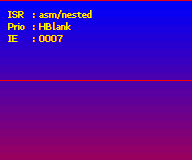
| A | Toggles between asm switchboard and C direct isr. |
|---|---|
| B | Toggles HBlank and VCount priorities. |
| L,R | Toggles VCount and HBlank irqs on and off. |
![]() {*@fig:irq-demo}a: Gradient; nested vct_wait_nested.
|
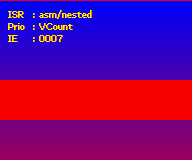
![]() {*@fig:irq-demo}b: Gradient; non-nested vct_wait.
|
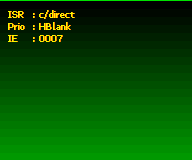
![]() {*@fig:irq-demo}c: Gradient; HBlank in master ISR in C. |
DATA_IN_x things allow global data to be put in those sections. Note that the default section for data is IWRAM anyway, so that may be a little redundant. `EWRAM_BSS` concerns uninitialized globals. The difference with initialized globals is that they don't have to take up space in ROM: all you need to know is how much space you need to reserve in RAM for the array.
The function variants also need the `long_call` attribute. Code branches have a limited range and section branches are usually too far to happen by normal means and this is what makes it work. You can compare them with ‘far’ and ‘near’ that used to be present in PC programming.
It should be noted that these extensions can be somewhat fickle. For one thing, the placement of the attributes in the declarations and definitions seems to matter. I think the examples given work, but if they don't try to move them around a bit and see if that helps. A bigger problem is that the long_call attribute doesn't always want to work. Previous experience has led me to believe that the `long_call` is ignored *unless* the definition of the function is in another file. If it's in the same file as the calling function, you'll get a ‘relocation error’, which basically means that the jump is too far. The upshot of this is that you have to separate your code depending on section as far as functions are concerned. Which works out nicely, as you'll want to separate ARM code anyway.
So, for ARM/IWRAM code, you need to have a separate file with the routines, use the `IWRAM_CODE` macro to indicate the section, and use `-marm` in compilation. It is also a good idea to add `-mlong-calls` too, in case you ever want to call ROM functions from IWRAM. This option makes every call a long call. Some toolchains (including DKP) have set up their linkscripts so that files with the extension *.iwram.c* automatically go into IWRAM, so that `IWRAM_CODE` is only needed for the declaration.